Sunday, October 3, 2010

First workshop day in Juzcar

Posted by Maggie

It is Sunday afternoon and we have just finished the first day of the workshop here in Júzcar, Málaga Province, Spain. We started the day with threats of rain, so stayed close to the hotel, but happily the rain never amounted to more than a few drops.
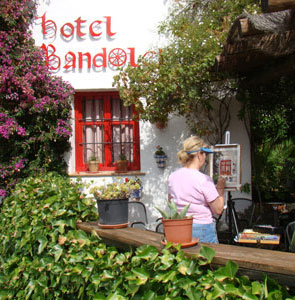
I gave a demonstration this morning, and then the painters scattered to various locations, mostly staying close in case the rain materialized. Hotel Bandolero has terraces and patios where people can spread out but still stay close to shelter. People painted throughout the morning, then took breaks for lunch or walks, and most went back to paint again in the afternoon. Painting the white buildings and red tiled roofs typical of the Genal Valley is not easy, and the changing light of the rapidly-moving clouds only complicates matters.

Nevertheless, every plein air painting is a learning experience, and each of the painters gained understanding of the subject as the day progressed. During the coming week, no doubt this subject will become more familiar and the paintings will improve, though in fact they were amazingly good for a first day.

After a little rest we will review the day's work, and then have another wonderful meal prepared by Chef Ivan. It's already a wonderful workshop.

Friday, October 1, 2010

A Day at the Alcazar

Posted by Maggie

We had a very full day yesterday. We began with a short river tour on the Guadalquivir, from which we could see many interesting buildings and bridges. Then we went back to the gardens at the Parque de Maria Luisa, as we had not seen nearly all of it the day before.

The park is a beautiful place, with a number of really interesting buildings on its outer edges, including the beautiful Plaza de Espana. Inside the park itself you would not know that you're in the middle of a busy city, as all you hear is the screeching of parrots and songs of other birds. We enjoyed exploring more of the park, and found some possible painting locations if we bring the group here next year.

After a late lunch we decided to go the the Palace of the Alcazar. We had explored the area outside the palace, and we thought it was not likely that we could take the group inside for painting, as there would probably be crowds and we might not be allowed to set up easels. Still, we thought it could be a good place for sketching, photography, and a good addition to the tour of Andalusia.

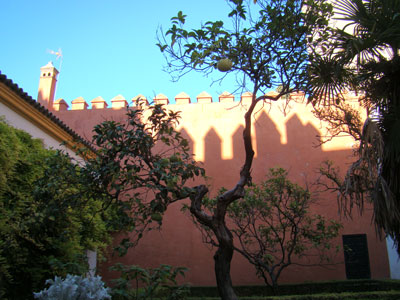
I had read that there were gardens connected to the Palace, but as always the photos and descriptions don't necessarily tell you what to expect. I actually enjoyed the gardens far more than the palace itself, as there was a wonderful combination of trees, bushes, palms, flowers and buildings. There were also fascinating arches and structures that weren't quite buildings but incorporated into the gardens in a way that could make wonderful compositions for painting. There were more colorful buildings and structures in the garden or visible from the garden, which could be really nice elements in a painting as well.

Some of the buildings in the Palace itself reminded me of the Alhambra Palace in Granada, where we took the group on our last Spain workshop and where we will go next week with the group. There were a lot of similarities in the architecture, but overall the Alcazar is not as crowded and not as large, so it would be possible for people to see more of it. I think it will work out well to change our itinerary for 2011 to have a day trip to Seville instead of to Granada. We'll have a shorter bus ride, and more time to explore and paint or sketch, and to see a little more of Andalusia.

By the time we left the Alcazar, we had walked for hours. We walked a little further to a restaurant that we had noticed on the other side of the river. The outdoor seating area was on the second floor terrace overlooking the water and with a view back towards the city. Because we arrived at the unfashionably early hour of 8 p.m., we were able to get a table right at the railing, and watched the sunset change the colors of the buildings and the lights beginning to reflect in the water. It was a perfect ending to a wonderful day.

Thursday, September 30, 2010

Sevilla Continued

Posted by Maggie

Our second day in Sevilla—the first full day—was wonderful in spite of some local problems. There was a general strike, which meant that no buses or taxis would operate, and many businesses were closed. Initially we thought it might create some difficulty but it did not interfere with walking and looking, so we were fine.

In the morning we walked to the area of the Alcazar and the Catedral. We encountered demonstrators, marches and speeches en route but never could quite comprehend what the strike was about. We enjoyed looking at the architecture, though finding potential painting locations was not easy. I am not happy about the idea of setting up a dozen or more easels in crowded areas, but I had thought it might be possible near a particular fountain (above right). However it was far too crowded, and I decided it might be a place for sketching and photography, but not easels. We walked to the entrance of the Alcazar but did not go in; we plan to do that on Friday.

Our guide book had mentioned a park and botanical garden so that was our next destination. It was a wonderful place, definitely on the list for potential painting spots. No admission charge, and broad streets closed to all vehicles except horse-drawn carriages and rented pedal cars, it would be comfortable for painters to spread out. There are abundant fountains, small pools of water, a small lake, and at one end a beautiful building for those inclined to paint architecture. The area in front of that building is being remodeled so was full of equipment and workers, but it looked near enough to completion to think it might be done by next year when we return.

After hours of walking, we found a tapas bar for lunch. I could happily live on tapas. I enjoy having a small portion of several different things to create an interesting meal. We still weren't quite recovered from the trip and jet lag, so the Spanish custom of afternoon siesta seemed a very good idea. When we went out once more, the late afternoon light was incredibly beautiful. The buildings that had been a dull beige or orange earlier glowed in the sunlight, and I took dozens of photographs.

In the evening we met friends for dinner. We walked quite a way in search of a tapas bar with some specific menu items, and while we never did find exactly what we wanted, we had a nice meal. It was fully dark by the time we headed back towards our hotels, and the walk beside the river was great. Some buildings which had not been very noticeable by day were spectacular at night, with beautiful lights and reflections.

Now it is morning in Sevilla and we are heading out to meet our friends and take a river cruise to see even more of the city by water. It is sunny and beautiful, likely to be very warm once again, and likely to be another wonderful day in Sevilla.

Tuesday, September 28, 2010

Exploring Sevilla

Posted by Maggie

We arrived in Madrid this morning (though what they claimed was 7 a.m. felt like midnight to us) after a long journey. We had several hours to wait in the Madrid airport before we could get our flight to Sevilla, and we spent most of those hours trying to stay awake. Finally on the airplane, we were able to relax and sleep until our arrival in Sevilla. Our bags arrived as well, we were lucky to get a friendly, courteous and careful taxi driver, and we liked our hotel the minute we got here.


After a little time to recuperate from the trip, we headed out for a short walk to see what was nearby. Our purpose here is to see if Sevilla would be a good option for a painting day trip for next year's Spain workshop, and we have a specific list of destinations to check out tomorrow and the next day. But, in an effort to stay awake until evening local time, we walked for a while this afternoon.


We are staying near the river Guadalquivr, and walked along it and across an interesting bridge. The architecture was interesting as well, even though we did not get nearly as far as the Catedral, the Alcázar or any of the more dramatic and distinctive structures we will explore tomorrow and the next day. Bill commented on the frequent use of gold and yellow trim on the white buildings, different than in the Genal Valley where the roofs of the white buildings are almost always red. Like some of the other cities we visit during our workshop day trips, there is a definite Moorish influence in the architecture. 

I wasn't expecting palm trees here. Our workshop location is in the village of Júzcar, Málaga Province, in the mountains. So I hadn't really thought about the fact that Sevilla is a lower altitude and farther south, and thus a bit warmer year round. The palms are wonderful, though, and so are the abundant flowers. I found a number of places along the river where I could be happy painting.

Facilities are important when you're picking plein air painting locations for a group of people. There has to be room to set up easels out of the way of traffic and pedestrians. It's nice if there is shade. And of course, we always try to find places to paint with nearby bathrooms. The people in Spain are remarkably accommodating in that regard—any restaurant or bar will let you use the "servicios" without question, although they are always happier if you buy a bottle of water or a snack.

After a couple of hours of walking, along with a stop for ice cream to rest and to cool off, we headed back to our hotel to rest. It's a bit too soon to decide if this beautiful walkway along the river will be a possibility for next year's painting workshop in Spain, though we might try it out ourselves if we have time. There was certainly no shortage of subjects in today's exploration—but we're off to explore further tomorrow, and who knows what other, even more wonderful things we might find!

Pastel Society of America's 2010 Exhibition

Posted by Maggie

As I mentioned in a previous blog, Bill and I were in New York to attend the reception and banquet for the Pastel Society of America's 2010 exhibition. It's always exciting to see the paintings—the amazing and wonderful variety of style, subjects and techniques demonstrated by the artists whose work hangs in the exhibitions. And it's fun to see the award winners. Like all artists, I don't always agree with the judges' decisions, but this year I applauded their selection of Rae Smith's painting (left) for the grand prize of $5,000, given by Jack Richeson in memory of Flora Giffuni. Its moody, mystical feeling caught my attention as soon as I saw it, and well before I knew who the artist was.


Rae Smith (left) is the President of PSA, and she spoke about some of the things the society has been doing since last year. One important project is carrying on Flora Giffuni's plan to get pastel teachers into the public schools to teach pastel, since art programs are so often the first thing to go when schools cut budgets.

Rae also presented the PSA Hall of Fame award to Richard McKinley (left), who is well-known in the world of pastel for his teaching and his Pastel Pointers blogs on The Pastel Journal web site. Richard is the 34th artist to be awarded the Hall of Fame designation; the award has been given annually since 1978.

Hearing about PSA activities, seeing the art and watching the artists receive awards is great, but another reason to attend this event is to see artist friends. It seems there are some people that I only see at the PSA banquet or the IAPS convention—though I'd love to see them more often, it just doesn't work out. It was great to see so many friends this year, and enjoy visiting with them before, during and after the banquet. In the photo at left, Jimmy Wright (Treasurer of PSA and a long-time board member of PSA and recently of IAPS) and Richard McKinley and I are visiting in the entry hall of the National Arts Club.

In the photo at left is Jack Richeson, with Rae Smith on his left, taken during the banquet. The banquet is held in the hall where the paintings are hung, so it's possible to continue enjoying looking at the beautiful art while enjoying dinner.
A final event at the PSA banquet is the raffling of a number of paintings donated by artists to help raise money for the society. Bill and I buy tickets, though we are both quick to explain that we never win anything, and just purchase tickets to support PSA. This year, though, to our great surprise, Bill won the painting Juicy Apple by Sangita Phadke (left).

I guess this means that either I can't continue to say we never win anything, or it's the beginning of a change in our luck and we should start buying lottery tickets! I'm hoping it's the latter, although we still won't win the lottery if we continue to forget to buy tickets.

Saturday, September 25, 2010

A lesson in light

Posted by Maggie

Today we visited the museum of the Hispanic Society of America, having heard that the large paintings by Sorolla had been re-installed.

Joaquin Sorolla y Bastida (1863-1923) was a Spanish painter whose work I have long admired for his handling of natural light on the subject. While I don't often paint the subjects he painted—figures, boats, etc.—I am inspired by the way he handles the light falling on and describing the subject. Part of my inspiration for my "sunlight and shadow" underpainting technique which I teach in workshops (and illustrated in my book, Painting with Pastels) came from observation of Sorolla's handling of light and shadow— that objects he painted in full sunlight tended to be warm yellows and oranges, while objects in shadow almost always contained some blue.

The large paintings at the Hispanic Society museum are stunning, and their placement lower on the wall since the remodel of the room in which they are displayed allows the viewer to more fully enjoy them. The fourteen large canvasses are about 12 feet tall, and range in width up to the largest one which fills an entire wall. Each painting deals with a specific region of Spain, and all but one were painted en plein air, despite their enormous size. Photographs taken on my camera cannot begin to do them justice; I hope you will find better images in books or on the Internet to enjoy them. But even with these poor images, you can see some of the wonderful color he used to describe light. In this photo at left (The Tuna Catch), the men on the far right are clearly dressed in white, but when you study the painting, you see that no white paint was used. The lights are described in pale yellows and oranges; the shadows are blues and lavenders, with bits of orange indicating reflected light. The only true white in this painting appeared to be the sparkles on the water.

A closer view of a detail of another painting further illustrates how he used colors to indicate light falling on a white object and his depiction of related shadow colors. There is so much to learn from studying these paintings, no matter what medium you work in. In this detail from the largest, most complex painting, what appears in the photograph to be white fabric is actually pale yellows. The shadows are exquisite blues and grays with wonderful bits of reflected light.

After we spent a considerable amount of time with these large works, we went upstairs to another gallery, and were pleased to find a few more paintings by Sorolla. One of these was his portrait of Louis Comfort Tiffany, painted in Tiffany's garden at his home. A little later, the curator of the gallery was preparing a presentation on a painting by Goya (which we attended and very much enjoyed) and, while waiting for the audience to arrive, he talked a little about the Sorollas. He pointed out that in this painting of Tiffany, there are only two areas of pure white paint: on the right sleeve of Tiffany's shirt, and on the edge of the sail in the harbor. All the other areas interpreted as white have color—Impressionistic color, he called it. 

After our visit to the Hispanic Society museum, we went to the Metropolitan Museum of Art for a few hours. It was truly visual overload, and by late afternoon, I could not absorb any more. I love the Met, and took the time to visit my favorite paintings there—but I think I will dream of the Sorollas.

Wednesday, September 22, 2010

Leavin' on a jet plane

Posted by Maggie

Tomorrow we're off to New York for the reception at the Pastel Society of America exhibition, and then on to Spain a few days later for a plein air painting workshop.

Not surprisingly, we've spent a lot of time getting ready. In addition to the obvious packing part of the preparation, we had deadlines to meet, and the house to get ready for the people who will be staying here while we are gone.

The packing's the hard part. Dressy clothes for New York, painting clothes for Spain. All the art supplies needed for the two of us to paint and teach a workshop.

I have a good checklist of the things I need to take when traveling by car to teach a workshop, and another one for traveling by air. I much prefer the car. I like picking something up, saying "I might need this, so I'll take it," and tossing it in the car. With the airplane bag limits, everything has to be considered in terms of weight and size.

We take one carry-on bag each, with our pastels, paper, and absolute essentials for painting. If our checked bags are lost, we can buy clothes, but art supplies can be tough to replace, especially in the area of Spain (a small village in the Genal Valley, in the mountains of Andalucia) where we hold our workshop. The nearest art supply store is probably 6 hours away, and I doubt if they carry my favorite pastels. Carrying pastels on the plane means allowing extra time for TSA to scrutinize our bags. Sometimes it takes a long time; other times they don't open them. Sometimes we get pulled out for extra inspection. Maybe it's because of the art supplies, or maybe we just look suspicious.

We put the easels in the checked bag. I use the Sun-Eden set-up shown here, and Bill uses a lightweight, inexpensive Winsor & Newton easel. If they get lost, it won't be convenient, but it won't be the end of the world. Also in the checked bags are extra paper, bungee cords, sketchbooks, watercolors, pens, pencils, hats and jackets. We take as many changes of clothes as possible (there are no laundry facilities in the village of Júzcar), but art supplies come first.

It's hard to decide what to leave out. I opted not to take my umbrella, much as I wanted it, but everything else in the photo here is going. The bag that's hanging off the easel is my carry-on bag; in this photo, my Heilman backpacker-size pastel box is already in it. 

The moment of truth is when we weigh the bags to be checked. We did well this time; one was 47 lbs. and the other 37. I moved a few things from the heavy one to the lighter one just in case the airport scales aren't as accurate as mine.

So, we're all ready,  and will soon be on our way. I'll be posting to this blog as often as possible during the next few weeks, with images of plein air paintings, painters and places. Hope you enjoy it!